Tracing Documentation Requirements for Tax Reporting in Multi-State Charitable Gaming Operations
Written by Devon Weber · Aug 24, 2026
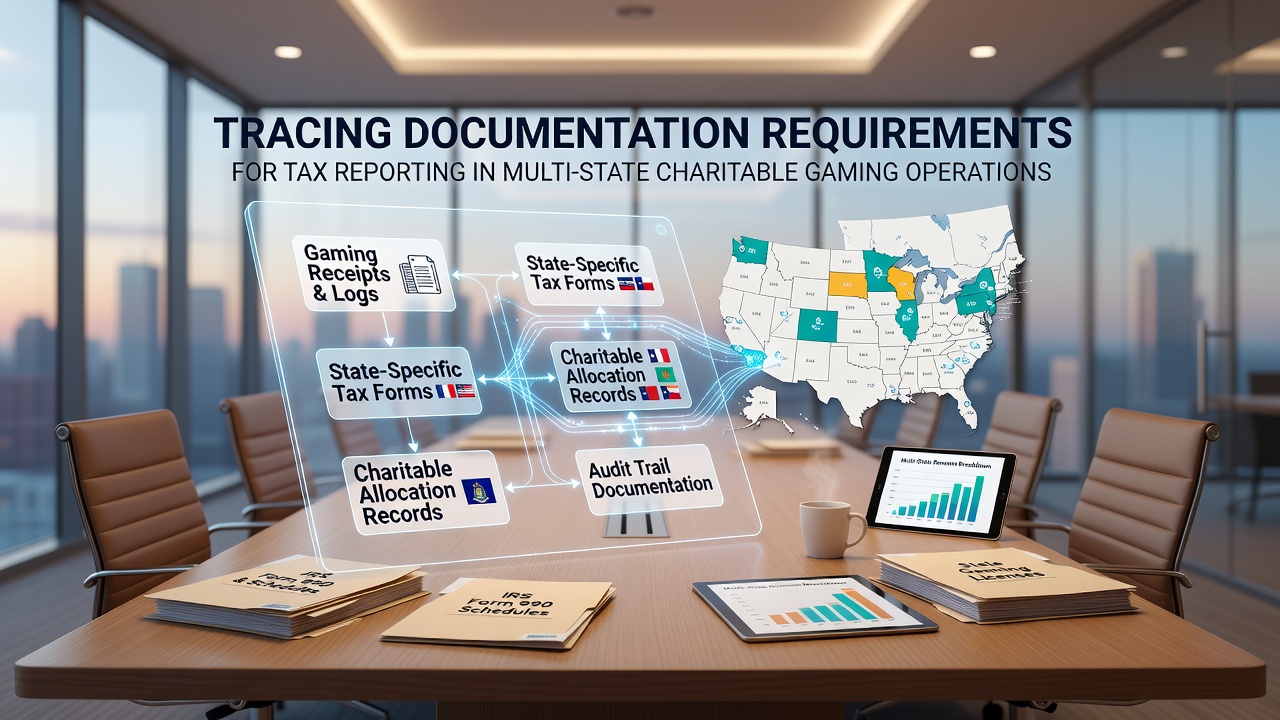
Tracing Documentation Requirements for Tax Reporting in Multi-State Charitable Gaming Operations
Charitable gaming operations that span multiple states face complex layers of tax reporting, and tracing documentation stands at the center of compliance efforts. Organizations must track every transaction from ticket sales to prize distributions while satisfying rules that differ from one jurisdiction to the next. Data from federal and state agencies shows these entities handle millions in revenue annually, yet the paperwork trail often determines whether an operation stays within legal boundaries.
Core Documentation Elements Across Jurisdictions
Operators maintain detailed ledgers that record gross receipts, allowable expenses, and net proceeds allocated to charitable purposes, and these records must separate activity by state because tax authorities require jurisdiction-specific filings. Research indicates that states like New York and Illinois demand player identification logs for certain high-stakes games, whereas others focus on expense verification through vendor invoices and payroll summaries. According to the Internal Revenue Service, exempt organizations conducting gaming must retain source documents for at least three years, with longer periods applying when audits extend across state lines.
Multi-state setups introduce apportionment challenges, so entities create allocation worksheets that assign revenue and costs based on player location or point of sale. Observers note that electronic point-of-sale systems now generate timestamped receipts that feed directly into these worksheets, reducing manual errors. In August 2026 several states updated their reporting portals to accept standardized digital files, allowing operators to upload batch data rather than paper forms.
State-Level Variations and Record Retention
Each state applies its own thresholds for when gaming revenue triggers additional filings, and operators therefore build master schedules that flag when activity crosses those lines. One study from the Multi-State Tax Commission revealed that thirty-eight states impose separate charitable gaming taxes, each with distinct documentation formats. Texas, for instance, requires monthly prize payout reports tied to player zip codes, while Pennsylvania emphasizes inventory tracking for pull-tab games sold across borders.
Retention periods also diverge, forcing organizations to adopt the longest applicable rule for any shared document. Figures reveal that some states mandate seven-year holds for records involving out-of-state players, and this forces centralized digital archives with role-based access controls. Those who manage these systems often implement automated alerts that notify compliance staff when a retention clock nears its end.

Technology Tools and Audit Readiness
Software platforms designed for gaming compliance now integrate with state tax APIs, pulling required fields automatically while preserving original source files. Experts have observed that blockchain-based ledgers appear in a growing number of operations because they create immutable trails of every ticket sale and payout. Such systems help when an audit spans several states, since examiners can query a single database rather than chasing separate spreadsheets.
Case examples show that operators who adopted unified dashboards reduced preparation time for combined federal and state returns by roughly forty percent. The same platforms flag discrepancies between reported proceeds and bank deposits, prompting immediate review before filings occur. In August 2026 several vendors released updates that added real-time currency conversion for any cross-border charitable events, though most multi-state gaming remains domestic.
Coordination Between Federal and State Requirements
Federal Form 990-T filings for unrelated business income must reconcile with state returns, and this reconciliation hinges on consistent categorization of gaming revenue. Researchers discovered that mismatches often arise from differing definitions of allowable expenses, so organizations maintain cross-reference tables that map each line item to every applicable rule set. A report issued by the National Council of State Legislatures in early 2026 highlighted ongoing efforts to harmonize these definitions across participating states.
Third-party audits serve as another checkpoint, and many states now accept reports prepared under uniform attestation standards. This acceptance reduces duplicate examinations while still satisfying individual documentation demands. Operators that schedule annual reviews with independent firms find they can address multi-state questions in one engagement rather than fielding separate inquiries from each revenue department.
Conclusion
Effective tracing of documentation remains essential for charitable gaming entities operating across state lines, and the combination of digital tools with jurisdiction-specific schedules supports accurate tax reporting. As regulatory portals evolve and retention rules stay varied, organizations that maintain centralized yet flexible record systems position themselves to meet obligations without unnecessary duplication. Ongoing updates in 2026 continue to shape how these records are created, stored, and reviewed.